Necessity obliges me to write
|
Priscilla Wakefield was the author of 17 books many of which ran into several editions both here and abroad. The books were mainly children's books and travel books; although Priscilla didn't travel far herself her books were based on extensive research. She wrote her first book at 43 and only began writing when it became necessary for the family income after her husband's business failed.
Priscilla desperately needed her books to sell and noted that her books such as Juvenile Travellers, chiefly recorded the actions of children whose parents have had leisure to superintend their education themselves, or have possessed fortunes sufficiently easy to pay persons properly qualified, to instruct them. She noted in the preface that she had heard children complain that moral tales were not likely to alter their conduct because 'they were not true, but merely fictions, to entertain.' And it was this that inspired her to produce Juvenile Anecdotes, which was composed mostly of incidents which had really occurred to children of her acquaintance. As well as natural history her books covered themes on which she campaigned such as the evils of slavery and the boycotting of slave-produced goods such as sugar and cotton. |
Received every encouragement relative to my writings that I can wish.
Let me guard against the vanity that naturally follows success’.
24 June 1796
Let me guard against the vanity that naturally follows success’.
24 June 1796
|
List of books in order of publication
1794-1796: Leisure Hours, or Entertaining Dialogues; between persons eminent for virtue and magnanimity ... designed as lessons of morality for youth.
1794-1797: Mental Improvement: or the Beauties and Wonders of Nature and Arts in a series of Instructive Conversations 1795-1798: Juvenile Anecdotes, Founded on Facts 1796: An Introduction to Botany: in a series of familiar letters, with illustrative engravings. 1798: Reflections on the Present Condition of the Female Sex; with Suggestions for Its Improvement 1801: The Juvenile Travellers; Containing the remarks of a Family during a Tour through the Principal states and Kingdoms of Europe (Her most popular work, of imaginative fiction reaching the 19th edition in 1850) 1804: A Family Tour through the British Empire Containing Some Account of Its Manufactures, Natural and Artificial Curiosities, History and Antiquities 1805 Domestic Recreation: Or, Dialogues Illustrative of Natural and Scientific Subjects, 1806: Excursions in North America, Described in Letters from a Gentleman and his Young Companion, to Their Friends in England 1807 Sketches of Human Manners 1809 Perambulations in London 1809 Variety; or, selections and essays, consisting of anecdotes, curious facts ... with occasional reflections. 1811 Instinct Displayed in a collection of well-authenticated facts, exemplifying the extraordinary sagacity of various species of the animal creation. 1814: The Traveller in Africa: Containing Some Account of the Antiquities, Natural Curiosities, and Inhabitants, of such Parts of that Continent and Its Islands, as Have Been Most Explored by Europeans 1816 An Introduction to the Natural History and Classification of Insects, in a Series of Letters, London 1817 The Traveller in Asia: or, a Visit to the Most celebrated Parts of the East Indies and China. With an Account of the Manners of the Inhabitants, Natural Productions and Curiosities. 1820 A brief memoir of the life of William Penn: compiled for the use of young persons "cultivate a taste in young persons for the study of nature"
by familiarizing the system of Linnaeus 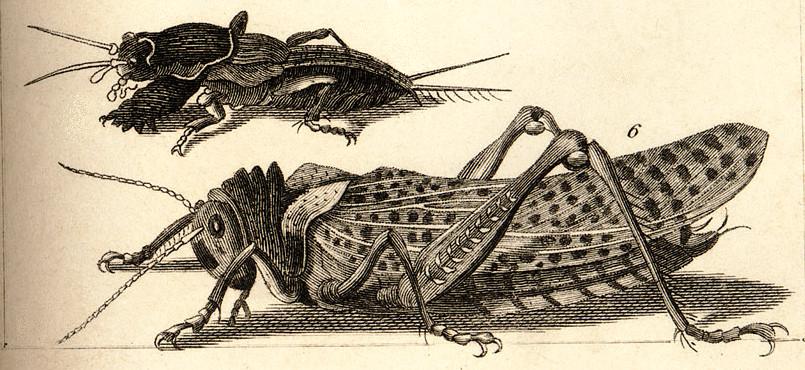 Grasshoppers Grasshoppers
Introduction To The Natural History And Classification Of Insects
I cannot dismiss this genus without mentioning the Curculio imperialis, or Diamond Beetle. It is a native of Brazil: the ground colour of the wing-sheaths is coal-black, but they are beset with many rows of sparkling spots, of a gold green, which, when magnified, display the varying lustre of the most brilliant gems. This appearance is produced by innumerable minute scales, so polished and united, as to reflect the prismatic colours in this lively manner. |
The harmonising beauty of creation and
the interesting objects it presents, have been my delight since childhood. 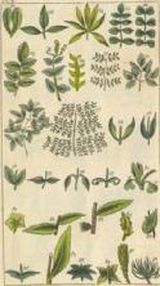
An Introduction to Botany published in 1796 was to become her most famous book. It was the first comprehensive survey of botany to be written by a woman and was so successful that it appeared in eleven editions over forty years, three editions in the US, and was translated into French. The format was 'a series of Familiar Letters with illustrative engravings'. The book became known as 'Wakefield's Botany".
Whenever you set out on a botanical excursion, remember to put your
magnifying glass and dissecting instruments into your pocket. The Juvenile Travellers; Containing the remarks of a Family during a Tour through the Principal states and Kingdoms of Europe The most famous of Priscilla Wakefield's travel books, first published in 1801, went into nineteen editions in fifty years. Her diary entry records "a large offer from Darton for the Juvenile Travellers"; the firm's records show that it was £200, as far as can be determined the largest sum paid by Darton and Harvey for any manuscript. The payment was a tribute to a major author, and an aristocrat among Friends, the great-granddaughter of Robert Barclay the Apologist; it was also an indication that Darton and Harvey were prospering. The publishers have produced a handsome book, bound in embossed cloth, with a hand-colored engraved map as frontispiece.
Perambulations in London published in 1809 is an educational guide to the city written for children which encompasses the Monument, the Guild Hall, the Mansion House, Royal Exchange, St Paul’s, the India House, the Tower of London, Westminster Abbey and the House of Lords. Included is Blake's poem The Chimney Sweeper.
1811 Instinct Displayed in a collection of well-authenticated facts, exemplifying the extraordinary sagacity of various species of the animal creation.
A nice little work, in the shape of letters between two young ladies who are induced to study natural history. The anecdotes are well selected, and told in a simple and unaffected manner, which greatly enhances their value. The object the authoress had in view is humane, and her book ought to be in the bands of every child from eight to twelve years of age. Bristol Mercury |
Publishers:
|
Elizabeth Newbery continued the publishing business established by John Newbery the pioneering children's book publisher who made a specialty of books for children, written by Quakers and others,
In 1787, the Quaker William Darton (1755-1819) began business as a printer, engraver and book publisher in London under his own name or as W. Darton & Co. Moving to premises at 55 Gracechurch Street in 1788, in 1791 he began a partnership with another Quaker, Joseph Harvey (1764-1841), setting up the firm of Darton & Harvey. They but also, following the path charted by and by the early 1800s the family firm was the established leader in the field. Priscilla's one book for adults, Reflections on the Present Condition of the Female Sex, with Suggestions for its Improvement, was brought out by the radical Unitarian publisher Joseph Johnson. |
Sources

|

The Hockliffe Project has been designed to promote the study of early British children's literature. It provides internet access to the Hockliffe Collection of Early Children's Books, located in Bedford in the UK. This website contains a catalogue of the Collection along with digital images of many of the books, plus bibliographical information and critical and contextualising essays. The Project’s aim is to facilitate a re-evaluation of children's literature in its own infancy, and to let these rich and varied books speak for themselves.
|

|
Contact: [email protected]
|